A customer walks into your shop on a Saturday morning. Twenty minutes later they either hand you a deposit or say “I'll think about it.” Most wrap deals are won or lost in that twenty minutes.
The shops doing 25%+ close rates aren't smarter or pushier than the rest. They've structured the conversation so that “I'll think about it” happens less often, and when it does, it's a fair pause instead of a polite no. This is how they run that conversation.
The five-step shape
Every consultation that closes follows roughly the same arc:
- Greet and frame (the first 60 seconds)
- Discover (what does this customer actually want?)
- Show (3D visualization, samples, options)
- Quote (numbers, in writing, with assumptions stated)
- Close or schedule next step
Out of order or skipped, the consultation fails predictably. In order with discipline, it closes.
The shops that close consistently are not the friendliest. They are the most structured.
Step 1: greet and frame
The first 30 seconds
The customer walks in. They're a little intimidated, even if they don't show it. They've never been in a wrap shop before, the bay smells unfamiliar, and they're about to discuss four-figure money.
Your job in the first 30 seconds: lower the temperature. Eye contact. A real greeting (not “be with you in a sec”). An introduction by name if the owner or lead is on site.
Frame the next 30 minutes
Once you've sat them down, tell them what's about to happen. “I'll ask a few questions about your car and what you're picturing, then we'll look at some options on the screen, then we'll talk numbers. About 30 minutes. Sound good?”
Customers settle when they know the shape of the conversation. The shops that just “wing it” lose people who hate ambiguity, which is most people.
Frame the meeting and the customer relaxes. Skip the framing and they stay on guard.
Step 2: discover
This is the part new shop owners skip and senior ones never do. Before you show anything or quote anything, you ask:
The five questions
- What's the car going to be used for? (Daily driver, weekend toy, show car, track)
- What are you trying to change? (Color, finish, full transformation, just one panel)
- Have you wrapped a car before? (Newbies need more education; veterans need less)
- Is there a deadline? (Birthday, show, sale of car, before a trip)
- What's the rough budget range? (Open this directly; they're usually relieved you asked)
Five minutes of asking saves 25 minutes of guessing. You now know what to show them, what to leave out, and what range to quote in.
The honest budget question
Customers expect this question. They're usually surprised when shops don't ask. The phrasing that works: “Just so I show you the right options, what's the rough range you had in mind, $3k, $5k, $8k+?”
Three things happen:
- If they have a real number, you save everyone time
- If they don't have a number, you've educated them on the bands
- If their number is unrealistic, you reset expectations early, not after they're emotionally committed to a $7k wrap on a $3k budget
Asking the budget feels rude on day one and obvious by year two. Senior shops always ask.
Step 3: show
This is where the consultation actually closes, and most shops still skip it.
3D visualization first, swatches second
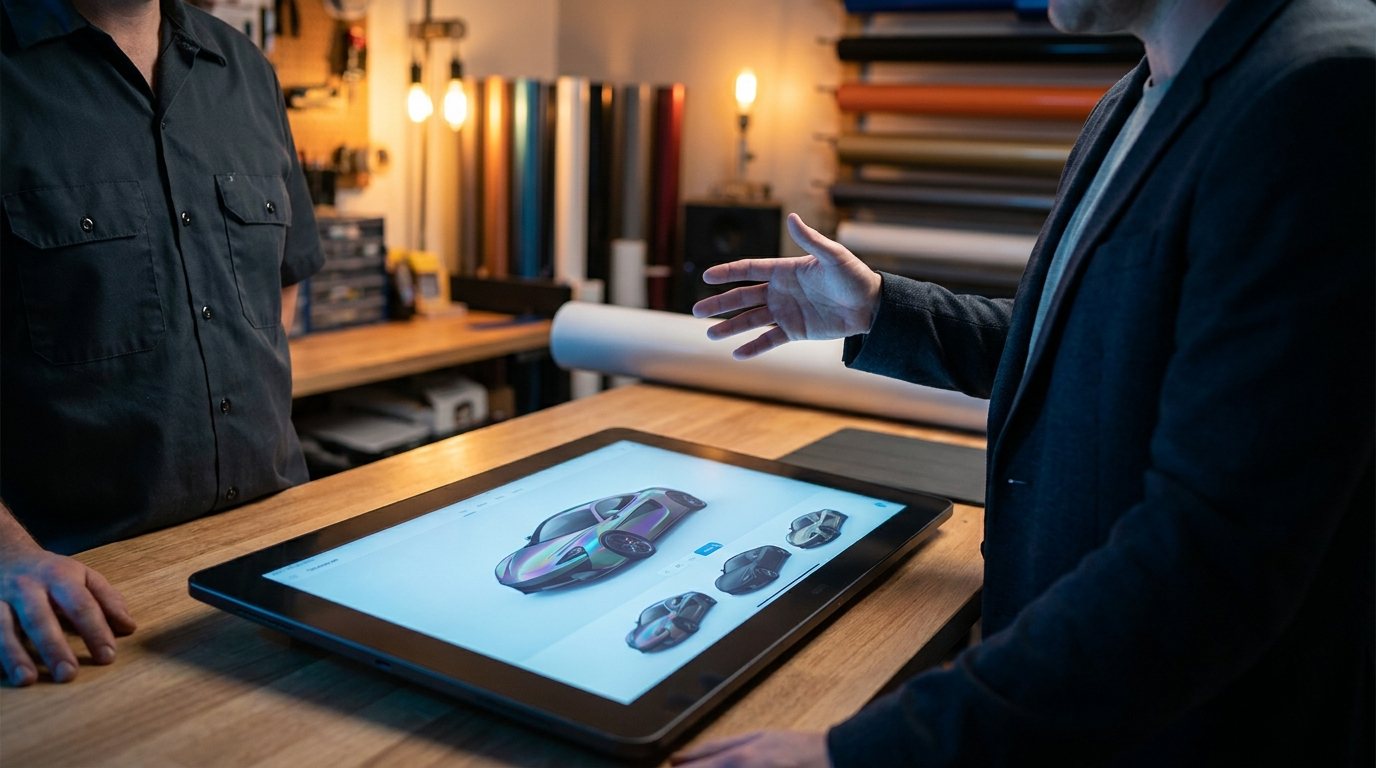
Pull up a visualizer (we make one, Zeno, but use whatever). Load the customer's exact vehicle. Drop in the finish they're considering.
The customer sees their actual car wearing the finish. Not a 2-inch swatch under fluorescent light. Not a stock photo of a different car. Their car.
If they hesitate, build a second option side by side. Same car, different finish. They will almost always point at one.
Physical samples confirm the material
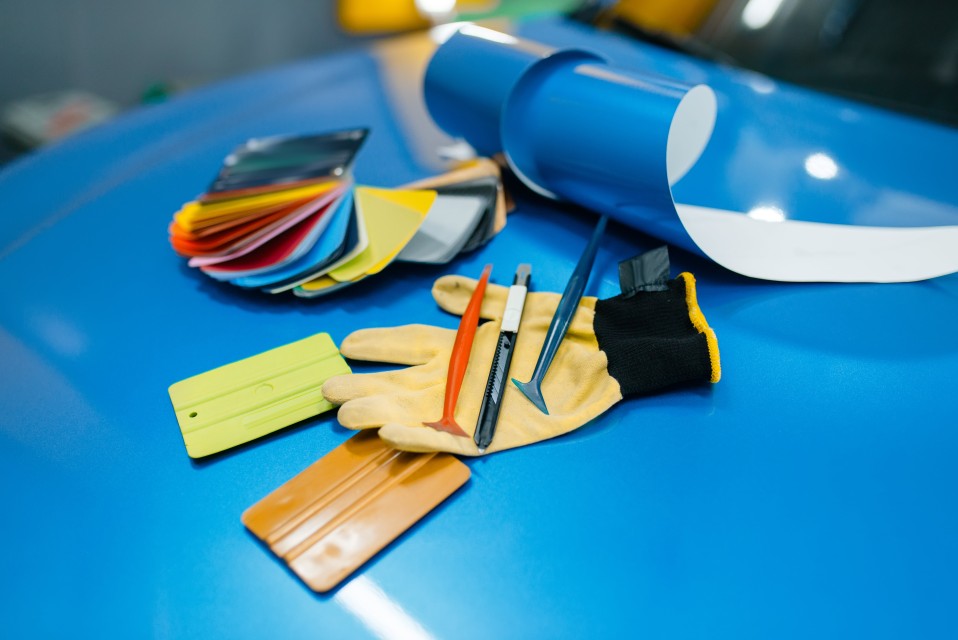
Once they've picked on screen, pull a real vinyl sample from the catalog drawer. Let them touch it. The visualizer tells them what it'll look like; the sample tells them what they're getting.
Send the render home
Before they leave, send them the render via text or email. Two reasons:
- They'll show their partner / friend / dad, who hasn't been to the shop. That conversation now happens around a real image, not a vague description.
- They'll keep thinking about it. The render lives in their text thread; the alternative is a fading memory of a swatch.
The shops that send renders home close on follow-up at 3x the rate of shops that hand over a business card.
Step 4: quote
Build the quote in front of them
Don't go to a back office and disappear. Don't email it later. Open your quote template in front of them and walk through it.
Material: $X (with brand and product code). Labor: Y hours at $Z per hour. Prep: $A. Premium for matte/metallic/color-shift: $B if applicable. Total: $T.
The price feels arbitrary when you hand them a number. The price feels fair when they watch you build it.
State assumptions explicitly
What's included: door jambs, door cups, badge removal/reinstall, fuel door. What's not: paint correction, body work, accessory removal, anything else. Write it down.
This is the line item that prevents most disputes 30 days later.
The warranty conversation
Cover this in plain language: what fails, what's covered, what's on them. Most customers have never owned a wrap; they don't know.
A clear quote is the cheapest insurance against an unhappy review.
Step 5: close or schedule
You've shown them the render, given them numbers in writing, answered their questions. Now the close.
The three reasonable next steps
Most consultations don't end with a deposit on day one, and they don't have to. The three healthy outcomes:
- Deposit today, install scheduled. Best outcome. Get the deposit, calendar the install, send the confirmation.
- Decision in 48 hours. They want to think. Set an explicit follow-up date with them in the room. “Should I text you Wednesday afternoon if I haven't heard back?” They almost always say yes.
- Different scope. The numbers are above their budget. Offer the alternative: a partial wrap, an accent, a different material. Don't end the conversation; redirect it.
What not to do
- Don't discount in the room. Holding price is harder than caving but compounds for years.
- Don't trash competitors. Customers don't trust shops that talk down other shops.
- Don't oversell. If the customer's car isn't right for a particular finish, say so.
A customer who walked out today and came back in 48 hours is worth more than a customer you discounted into saying yes.
What the numbers look like
The numbers shops see once the five-step structure is in place:
- Same-day close rate: 30-45% (vs 10-20% for unstructured consults)
- 48-hour follow-up close: another 20-30%
- Total close within a week: 50-70% of qualified consults
- Average ticket size: 15-30% higher than the shop's previous baseline (visualization drives trade-up)
These aren't fantasy numbers. They're what the shops we work with hit consistently once the playbook is in place. The shops below them are usually missing one or two of the five steps.
The single biggest mistake
If you only fix one thing about your consultation, fix this: show the customer their car. Not a swatch. Not a similar car. Theirs.
3D visualization is now a baseline. The shops using it close more, at higher prices, with happier customers. The shops still showing swatches under fluorescent light are the ones losing those customers without ever knowing why.
See the configurator cost breakdown for the budget math (spoiler: the math is easy, it pays for itself on one extra close per year).
The customer who saw their car wrapped is the customer who buys. The customer who imagined it is the customer who hesitates.