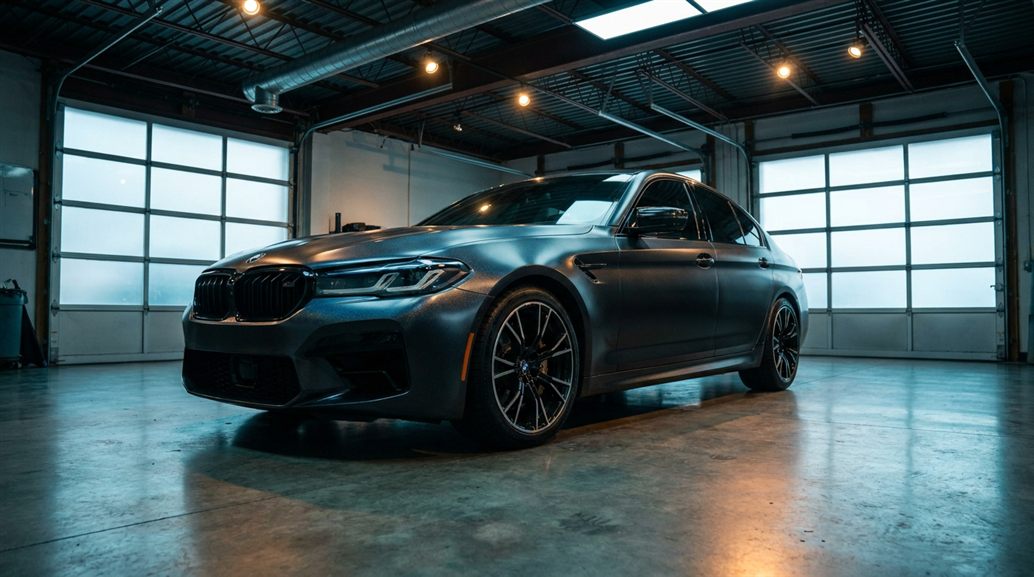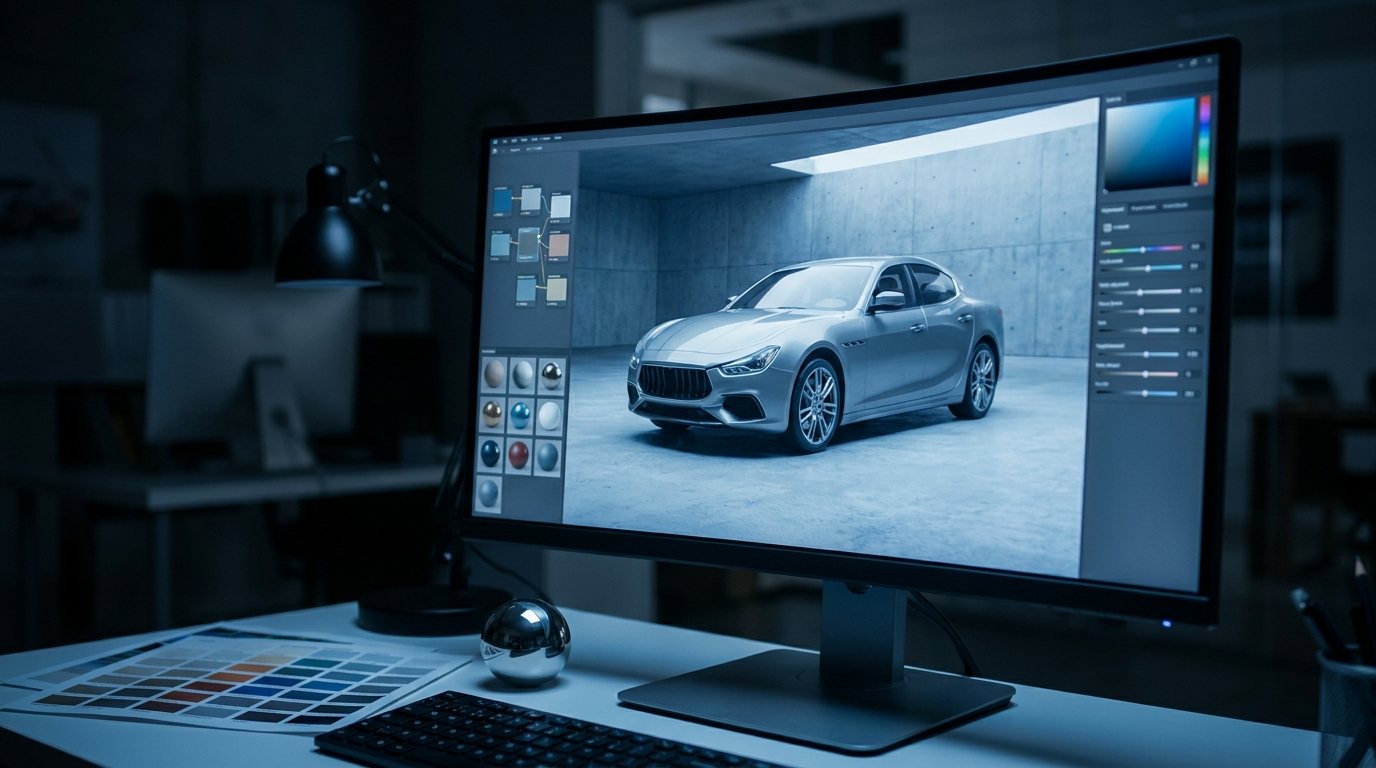
The job of automotive CGI is to be indistinguishable from a photograph of a real car. Most CGI doesn't get there. The renders that fool the eye are the product of five separate skills that almost nobody outside the studio sees. Looking at one of those renders, you can usually tell which of the five let the studio down.
If the language is new: CGI is computer-generated imagery, the 3D renders of cars that show up in print, broadcast, brochures, and on every brand configurator page. What follows is the inside view of what makes the difference between convincing and not.
The five craft skills
The five disciplines, in the order they touch a render:
- Model and topology (the underlying 3D mesh)
- Materials and shaders (how surfaces respond to light)
- Lighting (the choreography of light sources)
- Camera and lens (mimicking the optics of a real camera)
- Post-production (the final pass that lands the image)
Each is a deep specialty. Great CGI studios are great at all five. Mediocre studios are great at two or three and treat the others as afterthoughts.
The render that fools the eye is the one where every craft skill is dialed in. A weak link anywhere shows.
1. Model and topology
Every 3D vehicle starts as a mesh, a network of polygons defining the shape. The mesh comes from either CAD data (the engineering files from the manufacturer) or scan data (laser scans of the actual car).
What goes wrong
CAD data is precise but not always render-friendly. Engineering meshes have millions of polygons in places that don't matter visually (the underside of a bumper) and not enough where they do (the curvature of a fender). Cleaning a CAD model for render takes weeks per vehicle.
Scan data has the opposite problem: capturing the car as it actually exists, including manufacturing imperfections, dust, and dings, which the eye notices in renders and rejects.
What good looks like
A model with topology that flows along the car's design lines. Even polygon distribution where curvature is high. Clean edge transitions where panels meet. The kind of mesh you can subdivide three levels and it stays smooth.
A bad mesh is detectable from across the room. The eye reads silhouette before color.
2. Materials and shaders
The mesh is the shape. The material is how it reacts to light. Photoreal materials are where most CGI either succeeds or fails.
The discipline
Automotive paint, vinyl, glass, plastic, leather, metal, all behave differently in light. A photoreal render needs each one to behave correctly. That means understanding:
- Base color and how it shifts under different lighting temperatures
- Specular response (how shiny the surface is in direct light)
- Roughness (how blurred or sharp the reflections are)
- Metallic response (whether reflections inherit the surface color or stay neutral)
- Subsurface scattering (light penetrating a millimeter into the surface, key for plastics and pearl paints)
- Anisotropic flow (directional reflections on brushed metal, hair, fiber)
- Clear coat layering (the polished top layer on automotive paint, separate from the color layer)
The pearl/flake problem
Automotive paint isn't one layer. Modern pearl and metallic finishes are 3-5 layers: base coat, color coat with pigment, flake or pearl layer with metal/mica particles, optional iridescent layer, clear coat. Each layer responds differently to light.
Photoreal automotive paint shaders simulate all of this. The shortcuts you can take in product CGI (a single color with a basic specular) read as obviously fake on cars. The eye expects depth.
Cars look fake when paint is one layer. Cars look real when paint is the stack of layers it is in reality.
3. Lighting
Lighting is what makes the render feel like a real moment in a real place.
Studio lighting
Soft, controlled, shadowless. The visual language of car brochures since the 1980s. Easy to do badly. Hard to do well, because the absence of natural cues means every other element has to carry the realism by itself.
Environment lighting (HDRI)
An HDRI is a 360-degree photograph that captures the lighting of a real environment. The render engine uses it to light the car as if the car were physically present in that environment. A car on an HDRI of a parking lot inherits the parking lot's sun position, sky color, and surrounding building reflections.
HDRIs are the workhorse of contemporary photoreal CGI. The library matters: a great studio has hundreds of HDRIs captured at different times of day, in different weather, at different locations.
The supplementary rig
Even with a great HDRI, a photoreal render usually has 2-5 additional lights placed to highlight specific features: a rim light to separate the car from the background, a soft fill to lift shadow detail, sometimes a kicker to pop a body line.
The art is making this rig invisible. The eye should perceive natural lighting; the renderer should know there's a designed lighting setup.
Bad lighting tells the eye “this is a render.” Great lighting tells the eye nothing at all.
4. Camera and lens
The mesh and lighting are 3D. The output is a 2D image. The camera is the bridge.
Focal length
Real automotive photography uses specific focal lengths for specific shots. A wide-angle 24mm distorts the proportions in ways the eye reads as “sporty.” A telephoto 100mm compresses the perspective in ways the eye reads as “magazine cover.” A render with the wrong focal length feels off even when the customer can't articulate why.
Depth of field
Real cameras have a focus plane and bokeh (the blur outside the focus). Rendered cars without depth-of-field feel like CAD viewports, not photographs. The art is matching real-lens depth-of-field characteristics: not just blurring everything outside focus, but blurring it the way an 85mm at f/1.8 would.
Lens artifacts
Real lenses have characteristic flaws: vignetting at the edges, chromatic aberration on high-contrast edges, occasional flare. A small dose of these artifacts adds realism. Too much reads as fake. Calibration is the craft.
Cars look real when the eye perceives a photographer was there. The camera language is the proof.
5. Post-production
The final 5-10% of the work is what separates good CGI from great CGI.
Color grading
Every great car photo has been graded. Shadows shifted slightly cool, highlights warmed, contrast curved to match the brand's voice. A render straight out of the engine is technically correct but visually flat. A graded render feels like a finished image.
Atmospheric work
A subtle haze in the distance. Dust motes in a light beam. A hint of fog at the horizon. None of this needs to be obvious; all of it makes the scene feel inhabited.
Imperfection authorship
Real cars in real photos have fingerprints, dust, water spots, slight asymmetry in panel gaps. Truly photoreal CGI authors a small amount of these on purpose. Studios that ship perfectly clean renders ship images the eye reads as “too perfect to be real.”
Reality is full of small imperfections. Photoreal CGI authors them in on purpose.
Where the technology stops mattering
By 2026, the technology for photoreal automotive CGI is broadly available. V-Ray, Arnold, Unreal Engine 5, Octane, and several others can all produce indistinguishable-from-photo output if used by someone who knows what they're doing.
The differentiator is the “someone who knows what they're doing” part. Great CGI studios have:
- Senior artists with 8-15+ years of specific automotive experience
- Material and shader libraries built up over hundreds of projects, dialed in against physical references
- HDRI libraries captured by the studio in person, not bought off a stock site
- Review processes where senior leads tear apart junior work before it ships
- Reference culture: print magazines, real car photography, on-set time at OEM photoshoots
None of this is downloadable. None of this is in the manuals. All of it is the accumulated craft of practitioners.
The market mistake we see most
Brands buy CGI on price. Two studios pitch the same project; one is 40% cheaper. The brand picks the cheaper one. The renders come back, and they're “fine but not great.”
The brand can't always articulate what's missing. The customer can't either, consciously. But the customer's eye still reads the cheaper render as off. Conversion is lower. Engagement is lower. The brand pays the cost in performance, not in the line item.
The 40% savings on the build can cost three to five times that in campaign performance over the asset's life.
The cost of CGI is the line item. The cost of bad CGI is the conversion gap that nobody measures until the campaign is over.
What this means if you're commissioning CGI
The questions to ask a CGI vendor that separate great from average:
- Can we see a render side-by-side with a photo of the same car? (Not a render side-by-side with another render.)
- Who's the senior artist on our project, and how many years of automotive experience do they have?
- Are your shaders calibrated against physical paint chip samples?
- Are your HDRIs captured in-house or licensed?
- What's your review process before deliverables go to client?
The vendors that have good answers to all five are running real craft operations. The vendors that have good answers to one or two are running production studios that happen to do cars.
This is the standard the Partner team holds itself to, and the standard our customers (Ford, Avery Dennison, 3M, and others) hold us to. The technology is the easy part. The craft is the differentiator.
Buy CGI for the craft, not the cost. The craft you remember three campaigns later; the line item you don't.