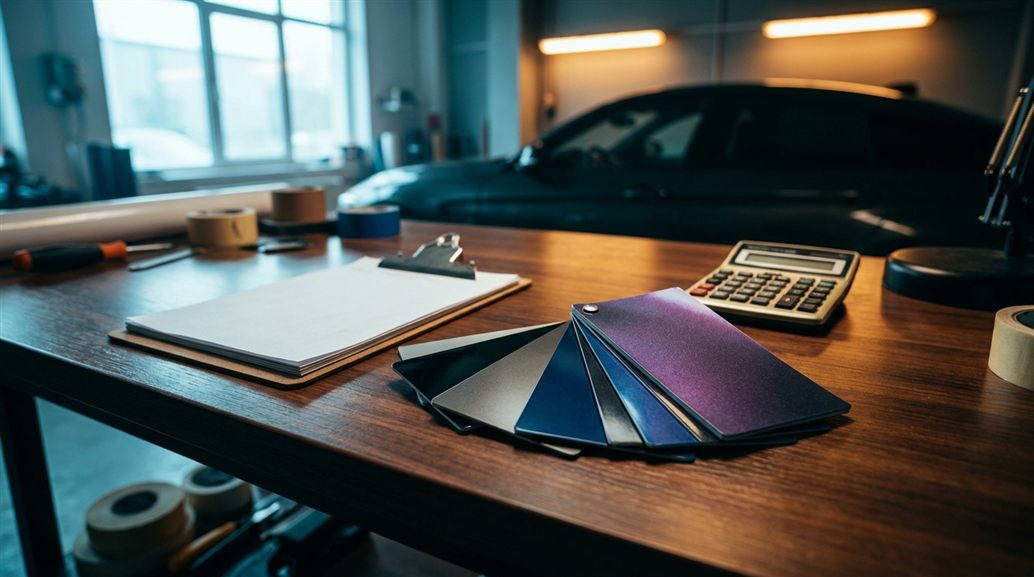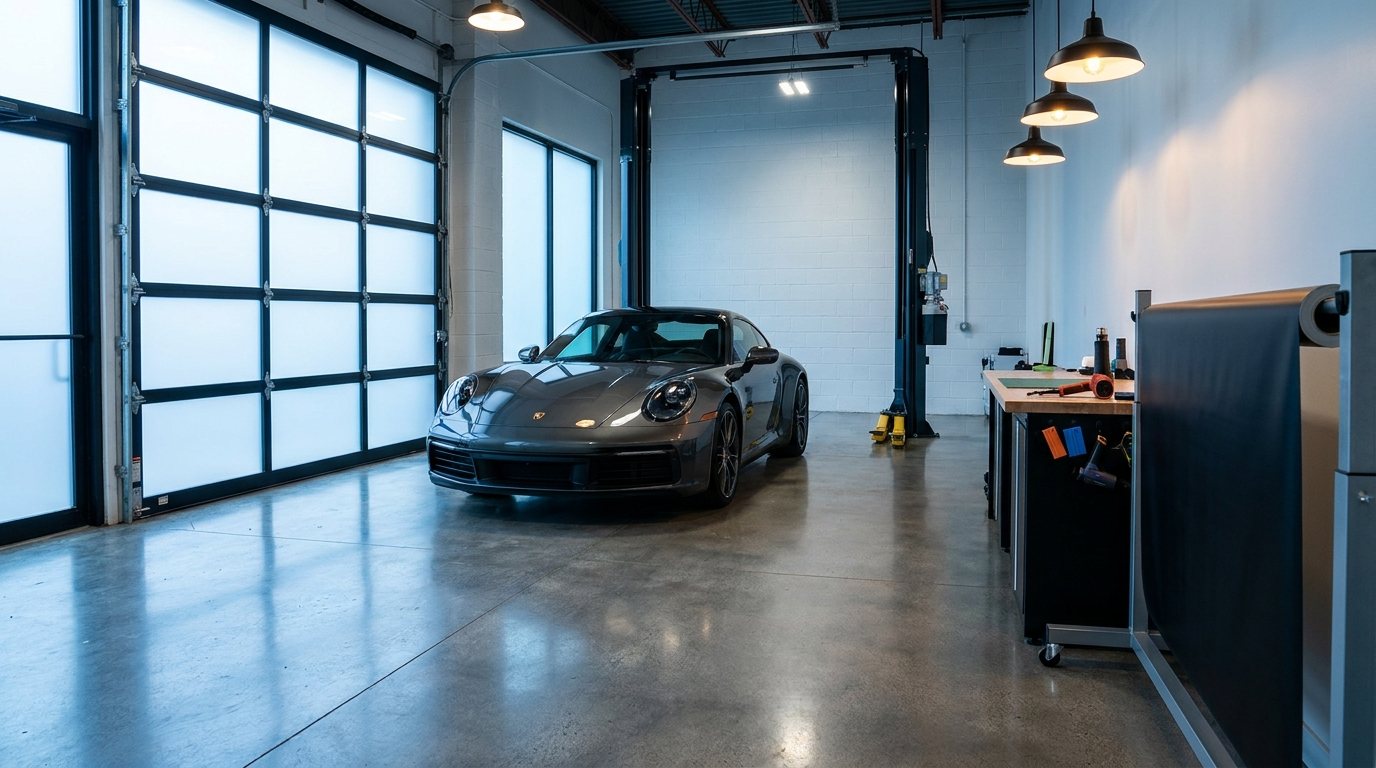
The business is most of the way to viable on day one if you do four things right. It's most of the way to closed inside a year if you don't. Wrap shops aren't a YouTube-Saturday business no matter what the YouTube-Saturday videos suggest.
What a wrap shop does, briefly, if the trade is new: customers bring their car in, the shop applies a printed vinyl film over the existing paint to change the color or finish, the customer drives home with what looks like a different car. Half craft, half logistics. This is the version of “how to start one” we wish more people had before they signed a five-year lease.
The honest startup budget
You will read $5,000-startup-cost YouTube videos. Those are influencer math, not real shop math. Here's what it actually costs to open a shop that can compete with the established ones in your city:
Space and lease
- Workshop bay, 1,000 to 1,500 square feet, with one big door and minimum 11-foot ceilings: $1,500 to $4,000 per month depending on city
- First/last/deposit: usually 2 to 3 months of rent up front. Budget $4,500 to $12,000
- Build-out (paint, lighting, flooring, climate control, modest reception area): $5,000 to $25,000
- Utilities deposit and initial bills: $500 to $1,500
Core equipment
- Heated installation lift (you'll thank yourself for the heat in year one): $3,000 to $9,000
- Plotter/cutter (the machine that pre-cuts vinyl panels from digital templates): $2,500 to $7,000 for a starter unit; $10,000+ for production-grade
- Heat guns (multiple, you'll burn out two in year one): $300 total
- Squeegees, knives, IR (infrared) thermometers, tape, blades, microfiber towels, IPA (isopropyl alcohol, used to clean paint before the vinyl goes on), prep wash supplies: $1,500 starter kit
- Air filtration / dust control: $500 to $2,000
- Lighting (5500K daylight LEDs throughout the bay so you can see what you're installing): $1,500 to $4,000
Software and digital
- 3D visualizer / configurator subscription (we make one, see Zeno, but use whatever you'll actually use): $100 to $200 per month
- Cutting software (KnifePrint, Inkscape, Illustrator, or the plotter manufacturer's bundled software): $0 to $80 per month
- CRM, calendar, invoicing tool: $30 to $100 per month
- Tablet for in-shop visualization, $400 to $800 one-time
- Website + domain: $20 to $50 per month
Marketing launch
- Branded shop signage: $1,500 to $5,000
- First three months of paid digital (Google + Meta): $2,000 to $5,000
- Inventory of starter rolls (3-5 popular colors, partial rolls): $2,000 to $4,000
The often-forgotten bucket
- Insurance (general liability, garage keepers, contents): $1,800 to $4,000 per year
- Business formation, accounting setup, initial legal: $500 to $2,000
- Three months of operating cash so you can pay rent if no jobs come in: equal to 3 × monthly burn
Add it up. A realistic single-installer wrap shop launch in 2026 is $40,000 to $80,000. Tighter is possible if you already own equipment or have a free space; lower than $30,000 means you're skipping something important.
The shops that survive year one are the ones that planned for year two from day one.
The skill question, asked honestly
Most aspiring shop owners fall into one of two buckets, and the answer to “what should I do first” depends on which one.
You can already install wraps well
You worked at someone else's shop, or you've been doing your own cars and a few friends', and the results are clean. You're ready to think about business. Skip to the next section.
You can't install wraps yet
You like the idea of the work and the numbers look good. Stop. Get good at the work first. The customer pays for the install quality, not for your business plan.
The path here is straightforward:
- Take a real certification course. 3M, Avery Dennison, XPEL, KPMF, and a few others all offer 3 to 5 day installer training. Budget $1,500 to $3,500.
- Wrap 10-15 cars before you sell anyone a job. Yours. Friends'. Old cars from Facebook Marketplace. Free or below-cost, while you're learning.
- Get someone better than you to look at your installs before you take money for one.
A great shop with a mediocre installer is just an expensive way to ruin paint jobs.
The four pricing decisions you have to make day one
We have a full pricing post if you want the deep version. The short version, for launch:
- Set a shop rate per hour you'll actually defend. $80 to $120 is reasonable for a new shop in most US/EU markets. Below that you'll go out of business; above that without reputation, you won't book.
- Calculate your overhead-per-hour from your real monthly costs divided by realistic billable hours. Most new shops land at $25-$40 per hour.
- Pick a margin target. 25 to 35% is healthy for a new shop. You'll feel pressure to discount; resist.
- Decide what's included in “full wrap” for you (door jambs? door cups? badges removed?) and put it in writing. Most disputes come from leaving this fuzzy.
Quote from a formula, not from your gut. Your gut will lose you money for six months before you notice.
The first ten customers problem
Marketing is the part most new shop owners get wrong. The reflex is to throw money at Google ads. That works once you have a few months of completed work to show, but in the first three months it usually doesn't, because new shops have no portfolio and customers (rightly) hesitate.
The order of operations that actually works:
Months 1-2: build a portfolio at break-even
Offer 5-8 wraps at material-cost plus minimal labor to friends, friends-of-friends, car-enthusiast clubs in your area, and any local influencer with a clean account. The deal: they get a deeply discounted wrap, you get to photograph and post every step.
Don't put yourself underwater. Hit material + 20% for labor. Pick cars that photograph well (interesting colors, clean condition, good shapes). Skip anything that's likely to come back with paint issues.
Months 2-4: turn each install into a week of content
Six pieces of content per car: intake photo, day-1 process, mid-install detail, walk-around video of the finished car, before/after still, handoff photo with the owner. Post across Instagram, TikTok, your Google Business Profile, and your website's case studies page. The full content cadence goes deeper.
Months 3-6: paid digital, carefully
Now you have portfolio. Now Google and Meta ads work. Budget $1,000 to $3,000 per month at this stage and watch the cost-per-lead carefully. You're looking for $80-$200 per qualified lead in most markets.
Months 6+: referrals and reputation
The shops that grow past month six grow on referrals, not on ads. Every customer is a potential source. The handoff conversation matters: take photos, send them a follow-up text at 72 hours, ask for a Google review at 30 days. Treat the post-install relationship like it matters, because it does.
Your first ten customers aren't your customers. They're your portfolio. Price them accordingly.
What you'll underestimate
The things people consistently get wrong on the way up:
How long each car actually takes
Your YouTube math says 25 hours for a sedan. Your first ten sedans will take 40+ hours. You'll get to 30 by car twenty. You might never get to 25 unless you're full-time, multi-car, with a real workflow. Price for the real number, not the aspirational one.
How much storage you'll need
Multi-day jobs mean cars sit overnight. A 1,000-square-foot bay holds one car comfortably with squeeze room. Two cars is tight. Three is impossible. If you grow past one installer, you'll outgrow the space before you outgrow the demand.
How much non-billable time eats your week
Consultations, quotes, social media, customer messages, accounting. None of it pays the rent. Plan for 30-40% of your work week being non-billable in year one. You can drop that to 15-20% with systems and a part-time admin, but not on day one.
How seasonal the business is
Most markets see wraps spike in spring (April-June) and fall (September-October), with a deep summer dip (July-August, too hot for outdoor enthusiasts to think about it) and a winter slowdown (December-February). Plan your cash reserves around this, not around your busiest month.
The two decisions that matter most
Out of all the choices a new shop owner makes, two of them quietly determine whether the shop is still around in three years.
Whether to add 3D visualization from day one
Customers in 2026 expect to see their car in the finish before they say yes. New shops that skip this step have to win every consultation on price, because they're competing with shops that can show the result. New shops that add it from day one close more, at better prices, with fewer hesitations.
The math is brutally simple: a 14-day free trial of a Pro-tier configurator, then $100-$200 per month for the subscription. Closes one extra job per year and it pays for itself. Closes two and it pays for itself plus the tablet. Read the configurator cost breakdown if you want the full ROI math.
Whether you specialize or generalize
Some shops do everything: wraps, PPF, tint, ceramic, paint correction, accessories. Others pick one. The generalists have more revenue surface but compete with everyone. The specialists have a clear story and tend to charge more per job.
For a new shop, pick one to be obviously great at. Add a second category six months in once the first is humming. Trying to do all four from day one is how shops dilute themselves into mediocrity.
Reputation compounds on the things you do consistently. Pick the thing.
What a good year one actually looks like
Realistic numbers for a single-installer shop in 2026, North American or European mid-size market:
- Q1: 4-8 wraps, mostly portfolio/break-even. Revenue $20,000 to $40,000. Most of it goes back into operating costs.
- Q2: 10-18 wraps as the portfolio starts pulling traffic. Revenue $50,000 to $100,000.
- Q3: 15-25 wraps. Revenue $75,000 to $150,000. You start considering a second installer.
- Q4: 12-20 wraps with the holiday slowdown. Revenue $60,000 to $120,000.
Total year-one revenue, healthy: $200,000 to $400,000. Healthy operating income: 15-25% of that. You're not getting rich in year one; you're proving the model works.
The close-it-down warning signs
Watch for these in the first six months. Any one is recoverable; two or more usually isn't:
- Quoting by feel instead of from a formula, six months in
- Discounting every quote that flinches at the price
- Not posting completed work consistently to social
- Doing the same install you did at car five at car twenty (no improvement curve)
- Treating customer messages as an interruption instead of as marketing
- Running on credit-card float because the operating cash buffer didn't get built
The shops that close don't close because demand wasn't there. They close because pricing, prep, and follow-through weren't.
What to do this week if you're seriously considering it
Concrete checklist, not a vision statement:
- Drive past three commercial bays in your target neighborhood. Note the rents on the windows.
- Get a real installer-training certification booked for the next available slot.
- Sit down with a spreadsheet and the numbers above. Plug in your local rents and rates. Get to a real launch budget.
- Look at the three best wrap shops in your city's Instagram. Note what they post, how often, and what their finished work actually looks like. That's your bar.
- Sign up for a 14-day free trial of a configurator. Run it on a tablet against three sample cars. Decide if visualization changes how you'd sell.
If after that the numbers still look interesting, you're ready to start. If they don't, you saved yourself a lease.
Wrap shops are good businesses to build, but they reward people who treat them like businesses from day one. The craft you can learn. The discipline is what separates the shop that's still around in three years from the one that wasn't.