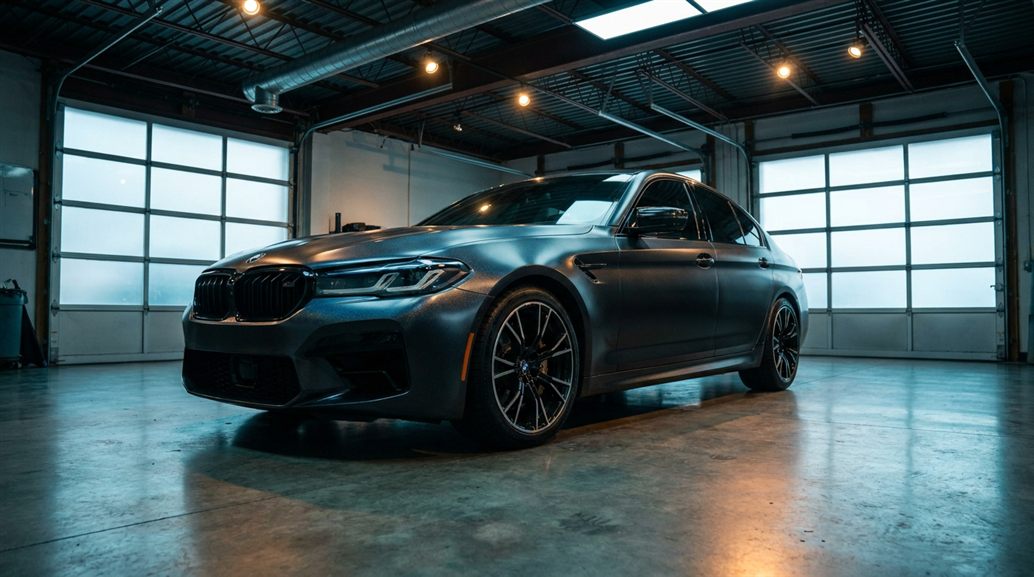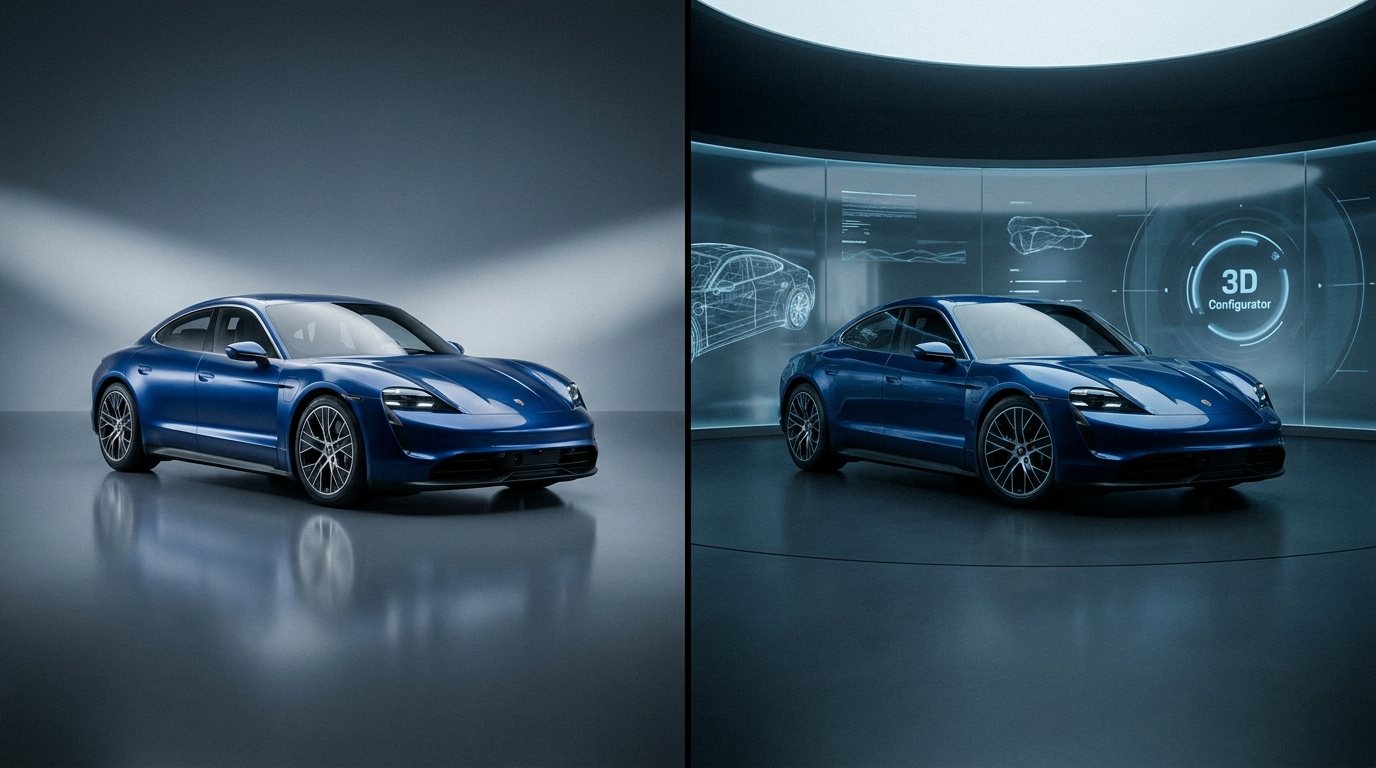
Every car brand has two 3D budgets. One pays for the hero shots in the print campaign (CGI: the photorealistic 3D renders you see in ads). The other pays for the configurator on the website, the tool where customers build their car in the browser. Most brands treat these as two separate functions and pay twice for them.
The brands that figured out how to pay once run a unified pipeline. This is how it actually works, and why it changes the economics of brand 3D.
The old way
Until about 2020, automotive brands typically had two separate 3D operations:
- A marketing-CGI agency that produced hero stills and brand films. Output: 4K photoreal images, broadcast-grade renders. Tools: V-Ray, Arnold, Maxwell, sometimes Corona. Render times: hours to days per frame.
- A web-configurator vendor that produced real-time interactive 3D for the website. Output: WebGL or proprietary real-time renders. Tools: Unity, Unreal, in-house engines. Render times: milliseconds.
The two operations rarely shared anything. Each one built its own version of the vehicle from scratch. Two sets of CAD imports. Two sets of materials. Two sets of vehicle libraries. Two sets of color-correction passes.
The result: a brand that wanted to launch a vehicle in print, video, web, and an AR app would commission four separate 3D builds from four separate vendors, often with subtly different versions of the same car shipping across channels.
Brands paid four times for the same vehicle, and the brand consistency was worse for it.
What changed
Three technical shifts converged around 2020-2023 to make the unified pipeline possible:
1. Real-time rendering became photoreal
Unreal Engine 5 (released 2022) and Unity's HDRP (high-definition render pipeline) crossed the threshold where real-time output became visually competitive with offline renderers for most marketing use cases. Render times dropped from hours per frame to milliseconds. Quality stopped being the trade-off.
2. USD became a real interchange format
USD (Universal Scene Description, an open file format for 3D scenes) gained traction across the industry. A vehicle authored once in USD can ship into Unreal, Unity, V-Ray, Arnold, and most other tools without re-authoring. Before USD, every tool needed its own version.
3. The catalog problem got solved
Brands moved away from ad-hoc 3D builds toward systematic asset libraries: every model, every trim, every color, every wheel, every accessory, authored once in a shared catalog. Once the catalog exists, every channel pulls from it.
Real-time rendering reached print quality. USD made files portable. Asset catalogs replaced bespoke builds. The unified pipeline emerged from those three.
What a unified pipeline actually looks like
The shared asset library
At the center, a library of every vehicle, every trim, every part, authored in USD with multiple LODs (levels of detail, simplified versions of the model for different output contexts). Stored centrally. Versioned. Permissioned.
The library is the source of truth. Every other system reads from it.
The materials catalog
Every paint code, every vinyl finish, every wheel finish, every interior leather, every plastic trim, captured as a material spec that renders correctly across all engines. When Pearl White Tricoat is authored in the materials catalog, it's identical in the V-Ray hero render and the Unreal real-time configurator.
The output pipelines
Four downstream pipelines pull from the same library:
- Print and OOH (out-of-home, the billboards and ads): high-resolution rendering, color-managed for the print process
- Video and broadcast: motion-graphics-grade rendering, often with cinematic post-processing
- Web and configurator: real-time, WebGL or native, with interactive cameras and customization
- AR and AI visualization: mobile-grade real-time, optimized for inserting the vehicle into customer photos or live camera feeds
Each pipeline knows how to consume the shared library and produce its specific output. No re-authoring at the asset level.
Author once, render four ways. That's the whole pipeline.
What it changes for the brand
Cost compresses
A vehicle that used to cost $80-150k to build across four channels now costs $40-70k total. The savings come from doing the expensive CAD-to-real-time work once instead of four times.
Time-to-market drops
A vehicle that took 6 months to roll out across all channels now takes 6-8 weeks. The slowest channel doesn't gate the others; all four pull from the same library as it gets built up.
Brand consistency improves dramatically
The hero image on the billboard, the spinner on the website, the AR experience in the app, all show the same vehicle in the same materials with the same proportions. Customers don't notice consistency, but they notice inconsistency, and the unified pipeline removes the latter.
Iteration becomes cheap
When the OEM decides to add a wheel option mid-cycle, the wheel gets authored once in the library and propagates to all four channels overnight. Old pipeline: four separate procurement cycles, three months, six figures.
The hidden win is iteration speed. Every channel updates the day the library updates.
What it costs to build
Realistic budgets for a brand standing up a unified 3D pipeline today:
- Initial library buildout (5-15 vehicles, full trim/color/wheel coverage, materials catalog): $300k to $800k, 4-9 months
- Real-time pipeline (configurator/AR-ready): $100k to $250k of that
- Print/video pipeline (hero CGI ready): $80k to $200k of that
- Tooling, infrastructure, asset management: $50k to $150k of that
- Ongoing maintenance: $15k to $60k per month, depending on catalog size and rate of change
Against the old way (separate vendors per channel, $300-600k per channel per cycle), the unified pipeline pays back in about 14-20 months for a mid-size brand. Faster for high-iteration brands.
The build vs buy decision
A brand can stand up a unified pipeline three ways:
1. Build internally
Hire a team of 8-15 (3D artists, technical directors, pipeline engineers, materials specialists). Buy the tools. Train the people. Time to first asset: 12-18 months. Total cost year one: $1.5-3m.
Right for: very large OEMs with constant 3D needs across many vehicles, where the team has ongoing work for years.
2. Hire a unified-pipeline agency
An agency that already runs a unified pipeline and can absorb the brand's vehicles into theirs. Time to first asset: 6-12 weeks. Total cost year one: $400k-1.2m.
Right for: most mid-size brands and aftermarket leaders. The agency's existing tooling and team is the lever.
3. Hybrid: own the library, outsource the pipelines
The brand controls the asset library and materials catalog. Different agencies handle each output pipeline (print/video/web/AR). Time to first asset: 8-14 weeks. Total cost year one: $600k-1.5m.
Right for: brands that want long-term ownership of their digital twin but don't have the leadership to run the full pipeline internally.
Build is right for very few brands. The right answer for most is some flavor of agency or hybrid.
The handover problem (and how to plan for it)
The hardest part of building a unified pipeline isn't the technology, it's preserving the brand's option to ever move it.
If your asset library lives at the agency, switching agencies in year three means rebuilding the library. Six figures of work, 6+ months of delay.
The contract clauses that matter:
- Brand owns the source USD files, the materials catalog, and any custom shaders developed for the work.
- On exit, the agency provides the library in a documented, importable form.
- Any proprietary tooling built specifically for the brand is delivered as source.
Good agencies agree to these terms without flinching. The ones that flinch are telling you something.
Build the library to be portable from day one. The single line item that costs $0 to add to a contract and saves seven figures later.
Where xix3D Partner fits
The Partner team operates exactly this kind of unified pipeline for brands like Ford, Avery Dennison, and 3M. The pattern we see most often is the hybrid: the brand owns the digital twin and the materials catalog, we operate the pipelines that feed marketing, e-commerce, and visualization.
The shop-side configurator (Zeno) and the brand-side AI visualizer (AI) both pull from the same engine, which is the same engine our partner programs run on. One technology backbone, four very different products on top.
If you're thinking through the unified-pipeline build, this is the conversation we have weekly. The technology has gotten dramatically more attainable in the last two years. The hard part is the operating model, not the rendering.
The pipeline is what every channel pulls from. Build it once, every channel improves at once.