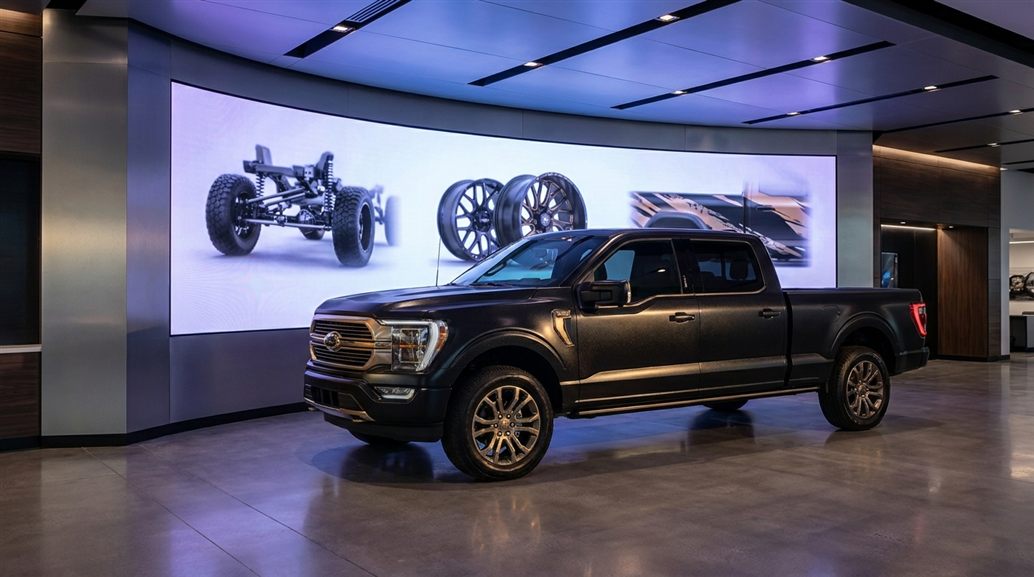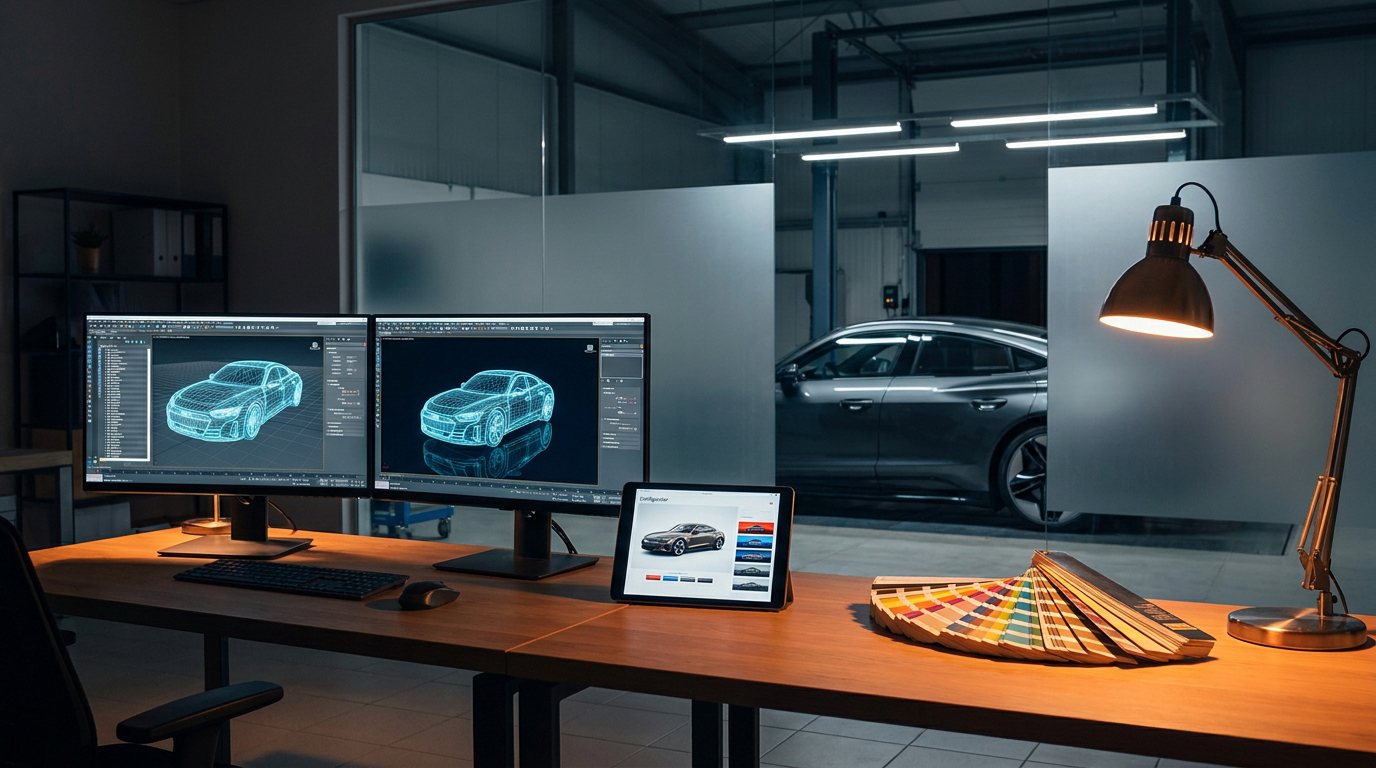
Every car brand needs CGI from someone. (CGI: computer-generated imagery, the photorealistic 3D renders of vehicles you see in print, broadcast, and on configurator pages.) The choice is in-house, external agency, or some hybrid. Each option has trade-offs that the procurement spreadsheet doesn't capture, and the wrong choice can quietly cost a brand a seven-figure number in the wrong direction over three years.
This is the version of the decision we wish more brands made before they signed contracts or started filing headcount requisitions.
What “3D” actually means at brand scale
The first source of confusion: “3D” covers four very different jobs, and they're often combined into one ask.
Marketing imagery
Hero shots, brochure spreads, billboards, social campaigns. Photoreal stills and short cinematic clips of vehicles, often in environments that don't exist (a car parked on a glacier, a concept car on a fictional racetrack). Used heavily in launches.
Configurators and visualizers
Interactive tools embedded in the brand's website. Customers pick a trim, a color, accessories, and see the result rendered in real time. The infrastructure overlaps with marketing imagery but the output is browser-driven, not film-driven.
Internal design and engineering visualization
Renders used by the company's own teams during product development. Different audience, different fidelity bar, often very confidential.
Catalog rendering at scale
Every trim, every color, every wheel, every accessory, every region. Thousands of images, generated systematically, refreshed annually. Boring, expensive, essential.
Treating “3D” as one category is the most common mistake. The four jobs have very different right answers.
The in-house pitch
Building a 3D capability internally is appealing for obvious reasons. Speed, control, deep brand familiarity, lower marginal cost on incremental renders.
What in-house gets right
- Brand fluency: an internal team learns the visual language fast and stops getting it wrong by month three. Color values, hero angles, environmental tone. Things a rotating agency roster has to re-learn each engagement.
- Iteration speed: a Slack message at 4pm becomes a render review at 9am the next morning. Hard to match externally.
- Confidentiality: pre-release vehicle data never leaves the building. For OEMs especially, this matters during the 18-month gap between camo testing and reveal.
- Marginal-cost economics on scale work: once the team and pipeline are built, the 500th render of the year costs almost nothing in incremental dollars.
What in-house gets wrong
- The buildout is slow. From “we should hire” to “first photoreal asset shipped” is rarely under 12 months, often closer to 24.
- The cost is bigger than the org chart shows. Senior 3D talent (lead artists, technical directors, pipeline engineers) costs $130,000 to $250,000 fully loaded in major markets. A real team is six to fifteen people. Plus licenses, plus hardware, plus the studio space.
- Skill diversity is hard. A great team for hero marketing imagery is different from a great team for real-time configurator engineering, which is different from a great team for high-volume catalog production. Most brands try to build one team that does all three. Most fail.
- The capacity is rigid. Internal teams are sized for steady-state. Launches, special projects, and global campaigns spike well above steady-state, and the internal team either burns out or hands the spike to an agency anyway.
In-house wins on steady-state economics and brand fluency. It loses on speed-to-launch and on spike capacity.
The agency pitch
The agency model is the historical default for automotive CGI, for reasons that haven't gone away.
What agency gets right
- Time to first asset is short. A good agency engagement produces meaningful output in 2 to 4 months, sometimes faster for marketing-grade single shots.
- Skill specialization is real. Agencies that focus on automotive build very deep expertise in vehicle topology, paint shaders, color science, and the visual conventions of the category. That's hard to replicate internally without years of investment.
- Capacity flexes. A launch quarter that needs four times the output gets four times the people. The brand doesn't carry the cost in slow quarters.
- Cross-pollination across clients: an agency working with five OEMs and three vinyl brands learns things that benefit each of them. None of which violates confidentiality if handled correctly.
What agency gets wrong
- Per-asset cost is higher than internal marginal cost. A hero still from a top automotive CGI studio runs $8,000 to $25,000. A configurator vehicle build runs $20,000 to $80,000+. Volume programs across thousands of assets get expensive.
- Brand fluency depends on team continuity. Good agencies build dedicated client teams that stay the same for years; bad ones rotate juniors through and the brand pays for the re-learning curve each engagement.
- Confidentiality bandwidth has limits. Highly secret programs (pre-launch reveals, design studies, future product) often need to live inside the company for legal or brand-strategy reasons.
- Vendor lock-in is real. Once a brand's color profiles, vehicle models, and pipeline conventions live at an agency, switching costs are non-trivial.
Agency wins on speed, depth, and elasticity. It loses on per-asset cost at scale and on the most sensitive programs.
The five questions that decide the answer
Costs are not the deciding factor. These five are.
1. How predictable is your volume?
Steady-state, high-volume catalog work? In-house starts to pencil after year two. Spiky, launch-driven, campaign-heavy work? Agency. A few brands run hybrids that are explicitly sized this way: in-house handles baseline catalog; agency handles spikes.
2. How fast does your business need to ship?
If “we need photoreal output in six months” is non-negotiable, agency. The 12-24 month build of an in-house team is not the right path. If you have 18 months of runway and patience, in-house becomes feasible.
3. How sensitive is the work?
Pre-launch product, design studies, internal-only assets: usually in-house, possibly with a vetted long-term agency partner under tight NDA. Public-facing marketing and configurator work: agency is fine and often preferable.
4. Do you have the leadership to run a creative function?
An in-house team without a strong creative director or head of CG fails predictably. They produce technically fine work that's brand-off, miss launch timelines, or burn out. If you don't have that person on the bench already, the agency is doing you a favor.
5. What's your three-year picture?
Brands sometimes build internal teams that solve a one-time problem, then realize they've created a fixed cost without a steady workload. The right framing is: what does this team do in year three, when the original need is gone?
The wrong reasons to pick in-house: “agencies are expensive,” “we want control.” The wrong reasons to pick agency: “we don't want headcount,” “it's faster.” Those are answers to a different question.
The hybrid model, which is usually the right answer
The configuration that consistently wins, at OEM after OEM, is some version of a hybrid.
The shape we see most
- A small internal team, 3 to 6 people, handles the work that has to live inside the company: pre-launch product, internal visualization, creative direction for everything else.
- A long-term agency partner (or two) handles marketing imagery, configurator builds, and catalog scale. The agency reports into the internal team's creative direction.
- A pipeline that lets assets move between the two without re-work. Shared color profiles, shared vehicle models, shared output specs.
Why this works
The internal team is small enough to staff with senior talent only, big enough to own brand direction, light enough to scale without burning out. The agency carries the spike capacity and the deep specialization. Neither side does the work the other is better at.
The brands that build pure-internal usually end up rebuilding as hybrid by year three. The brands that go pure-agency usually end up adding a small internal team by year three. The hybrid is where most teams arrive eventually, with a lot of waste along the way.
What the decision actually costs
Three-year cost frame, rough numbers, for a mid-size automotive brand:
Pure in-house
- Year 1: $1.5M to $3M (hiring, ramp, no meaningful output for 9-12 months)
- Year 2: $2M to $4M fully operating
- Year 3: $2.2M to $4.5M (talent retention costs, license inflation)
- Output: ramping, then full from year 2 onward
Pure agency
- Year 1: $800K to $2M (proportional to volume, faster startup)
- Year 2: $1.2M to $3M (steady-state volume)
- Year 3: $1.4M to $3.5M (scaled volume, possibly more launches)
- Output: full from month 4 onward
Hybrid
- Year 1: $1.4M to $2.5M (small internal team plus agency on launch volume)
- Year 2: $2M to $3.5M
- Year 3: $2.2M to $4M
- Output: full from month 6 onward, with creative-direction quality higher than either pure model
These are deliberately broad. Two brands with the same headcount can have 2x difference in real spend depending on senior vs junior mix, hardware refresh cycles, license tiers, and project scope. Treat the numbers as direction, not precision.
What goes wrong, in either direction
Failure modes we've watched repeatedly:
In-house failure modes
- Underestimating the leadership requirement. Senior CG leads are rare and the brands that build great teams treated their CG lead like an executive hire, not a technical one.
- Trying to be everything. The internal team gets pulled in eight directions and produces fine work in all of them, great work in none.
- Headcount tied to one program. The launch ends, the team has nothing to do, headcount sticks around as fixed cost.
Agency failure modes
- Treating the agency as transactional instead of as a partnership. Each project starts from scratch. Each project costs more than the last. Knowledge never compounds.
- Picking the cheapest bidder. Automotive CGI specifically punishes this, because the brand cost of an off-brand render in a $10M campaign vastly exceeds any agency-cost savings.
- Not investing in the handoff. The brand keeps no copies of the source files or the color profiles, and the agency owns the keys to switching cost.
Both models can fail. The model isn't what decides the outcome. The leadership and the contract structure are.
What an honest agency conversation looks like
If you do bring in an agency, the conversation that protects both sides has three parts.
What you're outsourcing, exactly
Not “3D.” Specifically: hero marketing imagery for the next two launches, configurator vehicle builds for the 2027 model year, and catalog catch-up across the existing lineup. Each is its own contract scope.
What stays internal, no matter what
Brand creative direction. Vehicle CAD security. Approval authority. Color reference and final-output sign-off. If you outsource these too, you're not hiring an agency, you're outsourcing your design function.
What the off-ramp looks like
What happens if you bring this in-house in year three? Who owns the source files, the vehicle models, the color profiles, the lookdev (the “look development,” the artistic process of dialing in materials, lighting, and rendering settings)? Put it in the contract. Reputable agencies will agree without flinching. The ones that flinch are telling you something.
How xix3D Partner fits this
Our Partner team has been on the other side of this conversation with Ford, Avery Dennison, 3M, and a number of brands you haven't heard about because the work is still confidential. What we've learned is that the brands who get the most out of working with us treat us like an extension of their team, not like a one-off vendor.
The work that lives best at an agency in this category: high-fidelity hero imagery, custom configurator builds, photoreal catalog rendering at scale, direct-to-consumer programs (like the Ford wrap program where we operate the entire seam from visualizer to certified installer network). The work that lives best in-house: creative direction, brand-specific lookdev definition, and the parts of the pipeline that are unique to the brand's process.
If you're working through this decision, the most useful conversation isn't “agency vs in-house,” it's “which parts of the workload go where, and what's the operating model that keeps both teams accountable.” That's the conversation we have weekly. Happy to have it with you.
The spreadsheet doesn't have the right answer. What your brand needs from 3D over the next three years does, and the model that gets you there with the fewest expensive mistakes is the one you want.